logo mobile

„Първата професионална работа, свързана с киното, започнах през май 1992. След конкурс на СБФД станах директор на Дома на киното, който програмирах до края на десетилетието. През това време успяхме да направим живота на много киномани по-цветен с многобройните събития, които се случиха там. По-късно се оформи екип, с който и до сега се занимаваме с фестивална, продуцентска и разпространителска дейност, както и менажираме Дома на киното. Цялата тази активност беше отличена с престижна награда на Европа Синемас през ноември 2012. 20 години е добър повод да се върнем назад във времето, да си спомним истории, хора, филми, музики, места по света и у нас... И така: 20 години – 20 теми.“ Стефан Китанов.


20 SELECTED INTERNATIONAL FILMS

20 SELECTED EVENTS

20 + 20 WORLD CINEMA MASTERS

20 OF KITA'S FAVORITE SONGS

20 + 20 + 20 WORLD CINEMA DISCOVERIES

20 SELECTED BULGARIAN FILMS

20 PRODUCED MOVIES

20 DISTRIBUTED FILMS

20 SELECTED BULGARIAN DIRECTORS

KITA'S 20 FAVORITE FILMS

KITA’S 20 EUROPEAN PLACES

20+2 BULGARIAN KITA’S PLACES

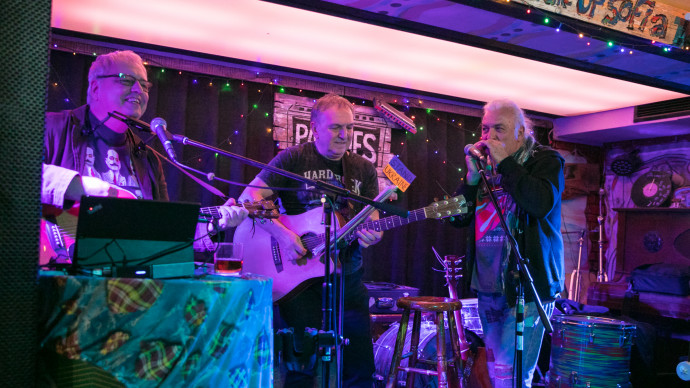
20 SONGS OF THE FESTIVAL BAND

20 PLANTS FROM MY GARDEN

20 SELECTED INTERNATIONAL FESTIVALS

20 BULGARIAN TOWNS WHERE SIFF HAS REGIONAL EDITIONS

Cinematographer Emil Hristov with the Sofia Award at the 30th Sofia Film Festival

The creative path of one of the established masters in Bulgarian cinema, Emil Hristov, extends over four decades. With his distinctive visual style, sense of light and dramaturgy, he is the author of some of the most significant feature and documentary film productions in Bulgaria such as "Zift", "The World is Big and Salvation Lurks around the Corner", "The Countess", "Losers", "Late Full Moon", "House No. 8", "Neon Stories" and others. Each film, shot with precision and perfectionism, bears his characteristic signature - carefully constructed atmosphere, strong visual concept and emotional depth. His work on "Zift" became a benchmark for stylish black and white cinematography in the recent history of Bulgarian cinema, and "The World is Big and Salvation Lurks Around the Corner" received international recognition and is the only Bulgarian film to date to reach the shortlist for the Oscar nominations in the international film category. In 2012, his directorial debut "The Color of the Chameleon" appeared on screen, an adaptation of the novel "Zincograph" by Vladislav Todorov, which received three awards at the Golden Rose festival, including best film. Emil Hristov also has extensive experience in television productions, music projects and advertising campaigns, where he has demonstrated his ability to combine artistic vision with the dynamics of contemporary visual formats. Over the years, he has established himself as one of the leading operators in the region and is the recipient of numerous professional awards and recognitions from film festivals in Bulgaria and abroad. With his consistency, professionalism and artistic approach, Emil Hristov continues to develop the visual language of Bulgarian cinema and inspire the new generation of filmmakers. In an effort not to miss the most important highlights of his creative path, we invited film critic Genoveva Dimitrova to write about him and the portrait will be published in the 30th Sofia Film Festival's catalogue - we present here a quote from her text. * * * "Bulgaria has at least a dozen outstanding cinematographers, some of whom work successfully abroad, yet among them all one name stands out: Emil Hristov (born August 13, 1956). From his early years to the present day, his presence in Bulgarian cinema has been associated with temperament and doubt, with perfectionism and radicalism – and with a notoriously difficult character. And, of course, with his ever-present scarf. In just a few years, the bold young rebel evolved into a star “big boss” of cinematography. In the late 1980s, visiting our film studies class at VITIZ (now NATFA), he remarked: “Bulgarian cinema is like the landscape outside the window.” In 1993, when I asked him in an interview for the newspaper Kultura how we might escape that landscape, he replied bluntly: “Pull down the blinds.”... Genoveva Dimitrova * * * WE ARE WAITING FOR YOU AT #CINEMA! #30SofiaIFF
FROM SIFF February 15 2026

Two Bulgarian films in the 30th Sofia Film Festival's International Competition

The Sofia Film Festival's International Competition for First and Second Feature Films is being held for the 24th year, and its jury will be responsible for awarding the Grand Prize "Sofia - City of Film", provided by the Sofia Municipality. Ralitza Petrova ’s debut feature “Godless” became a phenomenon with its success at Locarno and the Golden Leopard award, subsequently winning the Grand Prize for Best Film at Sofia Film Festival. Her next project “ Lust ” was eagerly awaited and will have its world premiere at one of the most prestigious festivals in the world – Berlinale, in the “Forum” section. The story follows Lillian, who works as a psychologist in an American prison, and after the death of her unknown father is forced to return to her hometown in Bulgaria. Passing through unresolved debts, institutional inertia and a decaying body stuck in a bureaucratic vacuum, the film traces the convergence of mourning, the body and the fragile border between power and submission. “ Lust” looks at the emptiness left by absent fathers and the burden that daughters continue to live with. The film is a psychodrama that moves between mystery, the imaginary and the ghostly - not to resolve the issues, but to trace how it shakes control and sometimes opens a gap ,” shares Ralitsa Petrova. The cast includes Snejanka Mihaylova, Nikola Mutafov, Mihail Milchev, Alexis Atmadjov; the cinematographer is Julian Atanasov. The film is produced by its screenwriter and director for Aporia Filmworks (Bulgaria), in collaboration with Poli Angelova and Nikolay Todorov for Screening Emotions (Bulgaria), with the support of the Bulgarian NFC Agency. The co-producers are the Danish company Snowglobe and the Swedish company Silver Films, with the support of the Danish Film Institute, Film I Vast and Eurimages. * * * " Women Out of Order " is the second full-length feature film by Alexander Kossev , whom the audience know as the director of the successful and beloved film "Petya of My Petya", watched by over 100,000 viewers in Bulgarian cinemas. The plot of the new work, whose screenwriter is Neli Dimitrova, intertwines the stories of four women, each of whom is at a different stage of her life. And although their problems are of a completely different nature, all four cannot get rid of the obsessive feeling that the meaninglessness around them is increasingly overwhelming. In conflict with age, femininity, love and pain, they desire change - extreme, painful, and unconditionally life-giving. Their emotions are conveyed by the actors Silvia Lulcheva, Albena Pavlova, Elena Atanasova, Alexandra Kostova, Vladimir Penev, Julian Vergov and others. The film's cinematographer is Mihail Yanakiev, the music is by Georgi Strezov, and the producer is Nikolay Urumov (Auris Film / BOF Pictures). Stay tuned for information about the other films in the International Competition and the programme of the 30th Sofia Film Festival! * * * WE ARE WAITING FOR YOU AT #CINEMA! #30SofiaIFF
FROM SIFF February 10 2026

Дейвид Макензи ще получи Специалната награда на 30-ия София Филм Фест

One of the most significant directors of contemporary cinema – David Mackenzie will be among the dearest guests of the 30th Sofia Film Festival and will receive the SIFF Special Award. David Mackenzie was born in 1966. The audience of Sofia Film Festival knows him well since his debut film “The Last Great Wilderness” (2002), included in the competition program of the festival in 2003. A year later, he captivated film lovers with his existential drama “Young Adam”, which brought him worldwide popularity. A film adaptation of the novel by the Scottish poet Alexander Troki, the film won the “Michael Powell” award for best British film at the Edinburgh festival. Mackenzie’s next two films – “Asylum” (2005) and “Hallam Foe” (2007) were nominated for the “Golden Bear” at the Berlin festival. This was followed by "Spread" (2009) and the captivating "Perfect Sense" (2011) starring Ewan McGregor and Eva Green, dedicated to the meaning of love in our troubled times. In 2016, his film "Hell or High Water" premiered in Cannes, starring Jeff Bridges, Chris Pine and Ben Foster, based on a screenplay by Taylor Sheridan, which received four Oscar nominations and more than 40 awards from around the world. In 2012, David Mackenzie was the chairman of the International Jury of the Sofia Film Festival, and now he comes with his two latest films - "Relay" (2024) and "Fuze" (2025), demonstrating his ability to combine genre traditions with dramatic human stories. Lily James and Oscar winner Riz Ahmed compete for the attention of the audience in the thriller "Fuze" - the main character helps potential whistleblowers deal with corporate offenders, while keeping his identity completely secret. One of his clients is a former employee of a biotechnology company who wants to return stolen documents in exchange for compensation. While the deal is being negotiated, the two are faced with the difficult choice between anonymity and the desire for personal contact, with one of the important questions being how to live in a world where it is increasingly difficult to remain unnoticed. According to the Financial Times, the film is a "stylish thriller that recalls 1970s classics," with "impressive work from actor Riz Ahmed." "Fuze" is a gripping and suspenseful thriller, full of unexpected twists, surprises and fast-paced action. After a World War II bomb is discovered on a construction site in a busy area of ​​London, the authorities react in a flash, determined to protect the many innocent bystanders nearby. Time runs out and it gradually becomes clear that no one can be trusted. The fast-paced "Fuze" is written by Ben Hopkins. The cast includes Aaron Taylor-Johnson, Sam Worthington, Gugu Mbatha-Raw and Theo James. In the tradition of gritty thrillers, combining elements of a crime mystery with the tense rhythm of skillfully constructed action, "Fuze" will captivate the attention of viewers in the program of the 30th Sofia Film Festival in March. David Mackenzie's visit to the 30th Sofia Film Festival is in partnership with the British Council, Sofia and marks the 35th anniversary of an exceptionally fruitful collaboration. * * * WE ARE WAITING FOR YOU at #CINEMA! #30SofiaIFF
FROM SIFF February 08 2026

София Филм Фест отбелязва 90 години от рождението на Вацлав Хавел

On the occasion of the 90th anniversary of the birth of Václav Havel , one of the most prominent figures of the European 20th century, the 30th Sofia International Film Festival in partnership with the Czech Center presents a special panorama of Czech films dedicated to the life, ideas and creative legacy of the playwright, dissident and statesman, who became a symbol of freedom and moral responsibility. The panorama, provided with the assistance of the Czech Center in Sofia , brings together documentary portraits and feature films revealing Václav Havel in his complexity and contradictions - as a writer and intellectual, as a man of doubt and irony, as a president, invariably guided by his conscience. Among the film highlights is the remarkable documentary Citizen Havel (2007) by Pavel Koutecki and Miroslav Janek, offering unprecedented access behind the scenes of the presidential institution. Filmed over a period of more than ten years, the film traces Havel's first terms as president of the Czech Republic - a period marked by political compromises, personal doubts and the clash between moral ideal and real power. The camera captures Havel as a man in a process of constant hesitation and self-reflection - vulnerable, ironic, sometimes tired, but consistent in his belief that politics must obey ethics. Václav Havel - Living in Freedom (2014) by Andrea Sedlačková presents a comprehensive portrait of Václav Havel, examining his life in a broader historical and cultural context. From his youth and his first theatrical successes, through dissident activities and years of repression, to his role as president and internationally recognized intellectual. The film emphasizes the idea of ​​freedom as a moral responsibility, which Havel defended both in his texts and in his public actions. Through archival footage, interviews and historical analysis, Václav Havel - Living in Freedom builds an accessible but profound story about a man who turned personal risk into a public duty. The latest documentary Havel Speaking, Can You Hear Me? (2023) by Petr Jančárek is a deeply personal and existential portrait of Václav Havel. Built on over 200 hours of archival footage shot in the last years of his life, the film reveals Havel far from the public image – as a man facing old age, illness, doubts and inevitable reckoning. Jančárek presents Havel as the “director of his own life” – with a sense of self-irony and a deep commitment to the idea that actions should be in harmony with conscience. The film received a strong international response. The feature film part of the panorama includes screen adaptations of Havel's texts and films directly related to his dramaturgy and worldview. Audience (1990) by the emblematic director Jiri Menzel and screenwriter Václav Havel is a screen adaptation of the first play from the so-called "Vanek Plays", in which the main character - a dissident writer - is forced to work in a brewery. His meeting with the master brewer develops into an absurd dialogue, oscillating between a "friendly conversation" and an interrogation. Audience is a classic example of Havel's absurdity, in which laughter and anxiety coexist. The direction of Jiri Menzel, one of Havel's closest creative associates, transforms the text into a powerful cinematic allegory of compromise, pressure and moral choice in a totalitarian society. The Beggar's Opera (1991), written by Jiri Menzel and Václav Havel, and directed by Jiri Menzel, is a loose adaptation of John Gay's classic The Beggar's Opera , reinterpreted through Havel's political and aesthetic sensibilities. The world of criminal gangs, corruption, and hierarchies of power becomes a transparent allegory of a society in which morality and law have been replaced. With Havel's typical humor and ironic distance, The Beggar's Opera reveals the mechanisms of power as a farce, behind which a cruel truth about human nature and social roles shines through. The only feature film directed by Václav Havel himself is an adaptation of his play of the same name Leaving (2011). The story of a former statesman refusing to leave his official residence becomes an absurdist meditation on the end of power, the fear of oblivion, and the inability to relinquish one's role. Leaving combines political satire, philosophical reflection, and autobiographical allusions, with many critics viewing it as Havel's belated, ironic farewell to politics. Who is Vaclav Havel Václav Havel (1936–2011) was a Czech playwright, essayist, dissident and politician, one of the leading voices of resistance against the totalitarian regime in Czechoslovakia and a key figure of the "Gentle Revolution". In 1989, he was the country's first democratically elected president, and later the first president of the Czech Republic. An author of plays marked by the absurdity and moral anxiety of the time, Havel remains a symbol of the belief that "living in truth" is a form of resistance. With this special panorama, Sofia Film Festival pays tribute to a person whose wisdom still reminds us today that freedom is not a given, but a daily choice. * * * WE ARE WAITING FOR YOU at #CINEMA! #30SofiaIFF
FROM SIFF February 06 2026
Cookie